





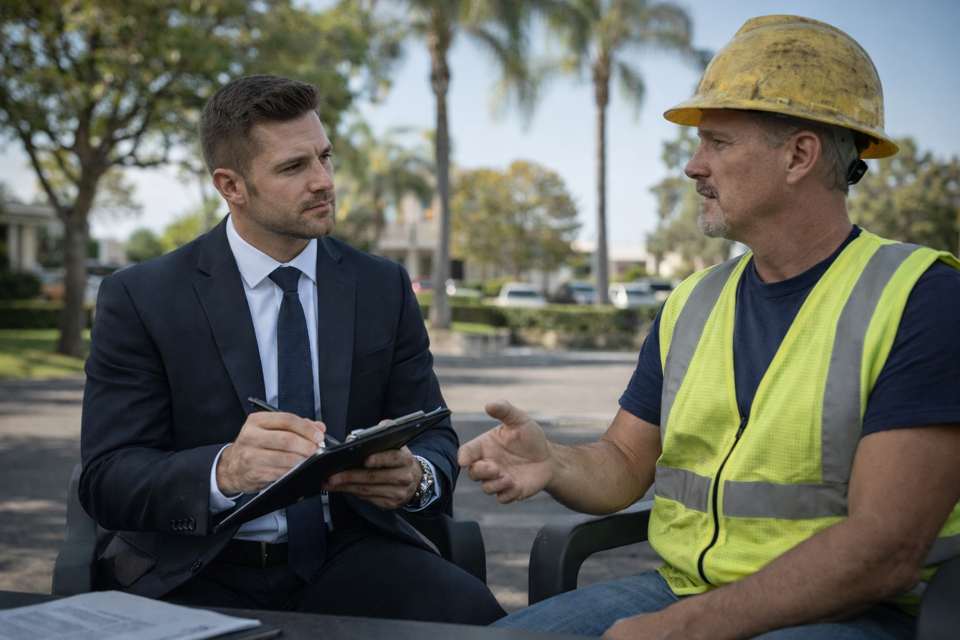
AOE/COE Investigation Checklist - Field-Proven Procedures for California Insurance Defense

When a workers compensation claim lands on your desk, the first question is always the same: did this injury actually arise from and occur during employment? The answer determines everything from reserves to litigation strategy. An effective AOE/COE investigation separates legitimate claims from questionable ones, and timing is everything.
For SIU managers and claims adjusters across Southern California, the difference between a 20% fraud detection rate and a 60-90% rate comes down to one factor: getting investigators in the field within the critical 7-14 day window after Date of Injury.
Key Takeaways
AOE/COE investigations determine whether a claimed injury both arose out of employment and occurred in the course of employment under California workers compensation law, directly impacting claim acceptance, denial, or defense strategy.
Early field investigation within 7-14 days of Date of Injury is critical because desktop investigations detect only 20% of fraud while field work with subrosa surveillance detects 60-90%.
OC Private Investigators, headquartered in Mission Viejo, delivers court-defensible AOE/COE evidence for SIU managers, claims adjusters, and insurance defense attorneys across Orange County, Los Angeles, and San Diego.
OCPI's federal-level behavioral analysis uses the 5-Channel Communication System and FACS certification to identify deception cues that standard interview techniques miss.
The boutique firm model with 24-48 hour deployment and no 1099 contractors ensures direct principal oversight on every California workers compensation investigation.
What Is An AOE/COE Investigation In California Workers Compensation?
An AOE/COE investigation examines two distinct legal tests that determine compensability under California's workers compensation system. AOE, or Arising Out of Employment, asks whether the injury has a causal connection to the work environment or job duties. COE, or Course of Employment, examines whether the injury occurred within the time, place, and circumstances reasonably incident to the person's job.
These investigations serve insurance carriers, self-insured employers, and defense counsel. The goal is to establish whether the claim meets both tests for coverage, or whether the evidence supports a denial or further inquiry. WCAB disputes in Santa Ana and Los Angeles routinely hinge on these exact fact questions.
For insurers, an AOE/COE investigation focuses on liability, compensability, and potential fraud detection. This work is not claimant advocacy or benefits counseling. It is evidence gathering for defense decisions.
How AOE/COE findings drive claim handling:
- Determine whether to accept, deny, or delay a workers compensation claim based on compensability factors
- Establish reserve levels by assessing injury mechanism credibility and treatment projections
- Provide panel defense counsel with court-defensible evidence for WCAB proceedings
- Identify subrogation issues when third-party involvement is present at the accident scene
Common claim types triggering AOE/COE questions:
- Cumulative trauma from repetitive lifting at an Anaheim warehouse
- Slip and fall at a Costa Mesa office with disputed cause
- Stress claims from Los Angeles call center employees
- Post-termination claims filed days after performance discipline
- Unwitnessed injuries at Newport Beach retail locations
Why Early AOE/COE Field Investigation Matters For Claims Outcomes
The $308 billion annual insurance fraud burden in the U.S. impacts every California workers compensation carrier and self-insured employer. That fraud adds $400-700 per year to the average American family's costs. Early stages of a claim offer the best opportunity to prove or disprove legitimacy before narratives solidify.
The 7-14 day window after Date of Injury is when memories are fresh, physical evidence remains at the Mission Viejo job site or Irvine tech office, and co-worker accounts have not been coordinated. After this window closes, witness statements become less reliable and potential fraud becomes harder to detect.
Desktop investigation limitations:
- Desktop investigations detect only 20% of fraud
- Field investigations with subrosa surveillance detect 60-90% of fraudulent or exaggerated claims
- On-site verification reveals physical inconsistencies that phone interviews miss
Claim handling pressure impacts:
Studies show that 53% of investigators report pressure to close claims quickly. This pressure often leads to inadequate investigation at the early stages, which exposes SIU managers and claims directors to adverse WCAB findings later. Early AOE/COE field work protects against this by establishing facts while evidence is available.
OCPI provides 24-48 hour deployment across Orange County, Los Angeles, and San Diego when adjusters flag red flags at FNOL. This rapid response capability ensures that critical evidence is secured before it disappears.
The 7-Step AOE/COE Investigation Checklist
The following checklist represents OCPI's field-proven methodology for conducting thorough AOE/COE investigations throughout Orange County. Each step builds toward a court-defensible report suitable for WCAB hearings and insurance defense strategy.
Step 1: File Intake and Triage
Review of DWC-1, employer's first report, prior claims index, ISO hits, medical records, and social media presence. This documentation review identifies early inconsistencies before field deployment. Investigators note employment gaps, prior injury histories, and any assignment details that require verification.
Step 2: Claimant Interviews with Behavioral Analysis
Recorded statements are conducted in locations like Santa Ana, Long Beach, or Chula Vista. The interview focuses on exact timeline, mechanism of injury, prior medical treatment history, and off-duty activities. Unrepresented claimants are contacted first to obtain detailed accounts before potential attorney coaching occurs.
OCPI's behavioral analysis approach applies the 5-Channel Communication System during these interviews to identify deception indicators that standard questioning misses.
Step 3: Employer and Supervisor Interviews
Site visits to Newport Beach retail stores, Anaheim hospitality venues, or Irvine tech offices allow investigators to interview witnesses who observed the injured worker before and after the alleged event. Topics include job duties, safety history, prior performance issues, and contemporaneous observations of the claimant's physical condition.
Step 4: Co-Worker and Witness Interviews
On-site interviews separate witnesses to avoid group contamination. Each person provides independent recall of what happened, when, and where. Investigators document whether accounts corroborate or contradict the claimant's version.
Step 5: Scene Inspections and Documentation
Physical documentation includes measuring distances, photographing stairways, loading docks, forklifts, or office workstations. Investigators note lighting conditions, safety signage, and surveillance camera locations that may have captured the alleged incident.
Step 6: Targeted Subrosa Surveillance
When behavioral red flags appear during interviews, subrosa surveillance may be deployed to document claimant activities. Video surveillance provides court-defensible evidence of functional capacity that contradicts claimed limitations.
Step 7: Records Collection and Social Media Review
Investigators gather timecards, GPS logs, safety reports, and internal communications. Public social media profiles are reviewed for posts inconsistent with claimed disability or injury mechanism. All evidence collection follows California privacy standards to ensure court admissibility.
Behavioral Analysis Integration Throughout The Investigation
OCPI's methodology goes beyond standard field investigation by integrating federal-level behavioral analysis at every stage. David S. Boone, the only Paul Ekman Certified Trainer in private investigation, applies the 5-Channel Communication System to assess credibility across five simultaneous data streams.
The 5-Channel Communication System:
Facial Expressions Microexpressions lasting 1/25th of a second reveal genuine emotional responses that contradict verbal statements. FACS certification enables precise identification of these involuntary leakage cues.
Body Language Posture shifts, barrier gestures, self-soothing behaviors, and illustrator patterns indicate comfort or stress during specific questioning topics. Changes in baseline behavior signal areas requiring deeper investigation.
Voice Patterns Pitch elevation, vocal tremor, speaking rate changes, and hesitation patterns correlate with cognitive load during deception. Voice stress analysis supplements other channels.
Verbal Style Pronoun usage, distancing language, timeline gaps, and evasive constructions reveal narrative construction rather than memory recall. Truthful accounts display consistent first-person perspective.
Verbal Content Detail level, logical consistency, and verifiable specifics distinguish genuine memory from fabricated narrative. Deceptive accounts often lack sensory details and contain logical impossibilities.
This science-based approach does not replace evidence. It identifies where deeper questioning, collateral interviews, or subrosa surveillance may uncover material inconsistencies in the claim narrative.
Scene Documentation And Evidence Collection
Physical scene documentation provides objective verification of injury mechanism claims. Investigators photograph and measure the alleged incident location, comparing physical reality against the claimant's account.
Scene inspection elements:
- Exact measurements of distances, heights, and clearances referenced in injury descriptions
- Lighting conditions at time of day matching the alleged incident
- Safety equipment, signage, and barriers present at the scene
- Surveillance camera coverage and retention policies
- Weather conditions and surface conditions documented with time-stamped photos
Equipment and workplace verification:
Investigators examine forklifts, pallet jacks, machinery, and tools referenced in injury narratives. Serial numbers, maintenance records, and operational characteristics are documented. This verification often reveals physical impossibilities in claimed injury mechanisms.
Witness proximity and line of sight:
Scene documentation establishes which co-workers could have observed the incident based on workplace layout, shift assignments, and job station locations. This analysis supports or contradicts witness availability claims.
Reporting Standards For WCAB Defense
OCPI emphasizes court-defensible evidence by documenting chain of custody, interview conditions, and methods consistent with California evidence rules. Reports are structured for immediate use by SIU managers, claims teams, and defense counsel.
Report structure:
- Executive summary with AOE/COE conclusions and supporting facts
- Detailed chronology from Date of Injury through investigation completion
- Witness statement summaries with consistency analysis
- Physical evidence documentation with photographs and measurements
- Behavioral analysis findings integrated throughout factual narrative
- Organized exhibits ready for WCAB submission
Neutral presentation:
Reports avoid advocacy language while clearly addressing AOE and COE elements. Investigators present facts, observations, and documented inconsistencies. Defense counsel receives reliable material for legal arguments without argumentative characterization.
Timeline documentation:
Detailed chronology from Date of Injury through investigation completion, including all interviews conducted in Santa Ana, Glendale, Oceanside, or Chula Vista. Each event is dated with exact times and locations.
Witness statement structure:
Each statement is summarized with exact dates, locations, and key quotes. A consistency assessment follows, comparing each witness account against other evidence and behavioral observations from the interview.
Evidence handling:
OCPI emphasizes court-defensible evidence by documenting chain of custody, interview conditions, and methods consistent with California evidence rules. This verification protects the report's integrity at WCAB and in any subsequent civil proceeding.
Expert testimony availability:
When matters proceed to hearing, OCPI provides litigation support and expert testimony about investigative procedures, timelines, and observations. This support gives insurance defense attorneys a comprehensive witness for their case.
Why Carriers And Self-Insured Employers Choose OCPI For AOE/COE Investigations
The difference between investigation firms becomes clear when a case reaches the WCAB. Reports prepared by volume-based vendors often lack the depth and credibility that administrative law judges expect. OCPI operates differently.
Boutique firm model:
OCPI is headquartered in Mission Viejo with no 1099 contractors and no outsourced work. Direct principal oversight from intake through report delivery ensures consistent quality and accountability on every assignment.
Principal credentials:
David S. Boone is the only Paul Ekman Certified Trainer in private investigation. His 20+ years with the LA County Sheriff's Department combined with advanced behavioral science training creates a methodology unavailable elsewhere.
Deployment capability:
24-48 hour deployment for AOE/COE investigations across Orange County, Los Angeles, and San Diego. Field investigators trained in federal-level behavioral analysis respond when adjusters identify red flags at FNOL.
Science meets investigation:
The methodology supporting SIU managers, claims directors, and insurance defense attorneys combines proven investigative techniques with behavioral credibility assessment. This produces reliable, court-defensible AOE/COE evidence.
For general private investigation services, OCPI brings the same standards. Self-insured employers and corporate clients requiring internal investigations receive the same principal-led attention to every case.
When To Engage OCPI On An AOE/COE File
Timing decisions determine investigation value. The following guidance helps B2B decision-makers identify when field work adds the most value to a claim.
7-14 day window triggers:
- Delayed reporting by claimant
- Unwitnessed injury with no corroborating evidence
- Conflicting versions from employer and employee
- Mechanism description inconsistent with job duties
Immediate referral situations:
- Cumulative trauma alleged without clear mechanism in high-risk sectors
- Logistics claims from Santa Ana distribution centers
- Hospitality injuries at Anaheim venues
- Healthcare worker claims in Los Angeles facilities
Automatic candidates for enhanced investigation:
- Post-termination claims filed within 30 days of discipline or separation
- Psychological or stress claims with vague onset dates
- High-exposure injuries in San Diego and Orange County with reserve concerns
- Claims where subrogation issues suggest third-party involvement
Pre-litigation timing:
Defense attorneys should bring OCPI in before WCAB conferences or depositions. This allows time to tighten timelines, refine witness lists, and test claimant credibility with behavioral analysis before the hearing date arrives.
Contact OC Private Investigators to discuss assignment details and deployment timing for your pending AOE/COE file.
FAQ: AOE/COE Investigations with OC Private Investigators
How fast can OC Private Investigators start an AOE/COE investigation in Southern California?
OCPI typically deploys within 24-48 hours across Orange County, Los Angeles, and San Diego once assignment details and authorizations are received from the carrier, TPA, or self-insured employer. Early deployment maximizes witness cooperation in cities like Mission Viejo, Irvine, and Santa Ana. It also preserves evidence before job sites change, surveillance footage is overwritten, or witnesses coordinate their accounts.
Can OCPI provide expert testimony about AOE/COE findings at the WCAB?
OCPI supports insurance defense attorneys with testimony about investigative procedures, timelines, and observations in WCAB proceedings. Reports and testimony are structured to meet court-defensible standards that administrative law judges expect. This litigation support extends through deposition, hearing, and any subsequent civil proceeding where the investigation becomes relevant.
How does OCPI handle sensitive internal investigations when the employer is self-insured?
OCPI works directly with corporate HR directors and risk managers in Mission Viejo, Newport Beach, Los Angeles, and San Diego to conduct neutral AOE/COE and related internal investigations. The boutique model and no 1099 contractors policy ensure confidentiality, consistent methods, and principal oversight. Self-insured employers receive the same evidence standards as carrier clients, with reports structured for compliance and legal review.
What makes OCPI's behavioral analysis different from standard interview techniques?
David S. Boone's status as the only Paul Ekman Certified Trainer in private investigation, combined with FACS certification, enables structured use of the 5-Channel Communication System during AOE/COE interviews. This behavioral analysis approach identifies leakage across facial expressions, body language, voice patterns, verbal style, and verbal content. The technique does not replace evidence but enhances it by identifying where deeper questioning, collateral interviews, or subrosa surveillance may uncover material inconsistencies.
How should SIU managers or claims adjusters initiate an AOE/COE assignment with OCPI?
Contact OC Private Investigators directly via the website contact form or phone for a free consultation. OCPI will review claim documents, clarify objectives, and propose a tailored AOE/COE investigation plan based on the specific facts of your file. The boutique model ensures direct principal involvement from initial assignment through final report delivery.